Nature as an Ally for Clean Drinking Water
With the LIFE Watersource project, PWN is researching the Climate Buffer IJsselmeer. This will help us continue to produce sufficient and reliable drinking water, not only now but also in the future.
This is LIFE Watersource
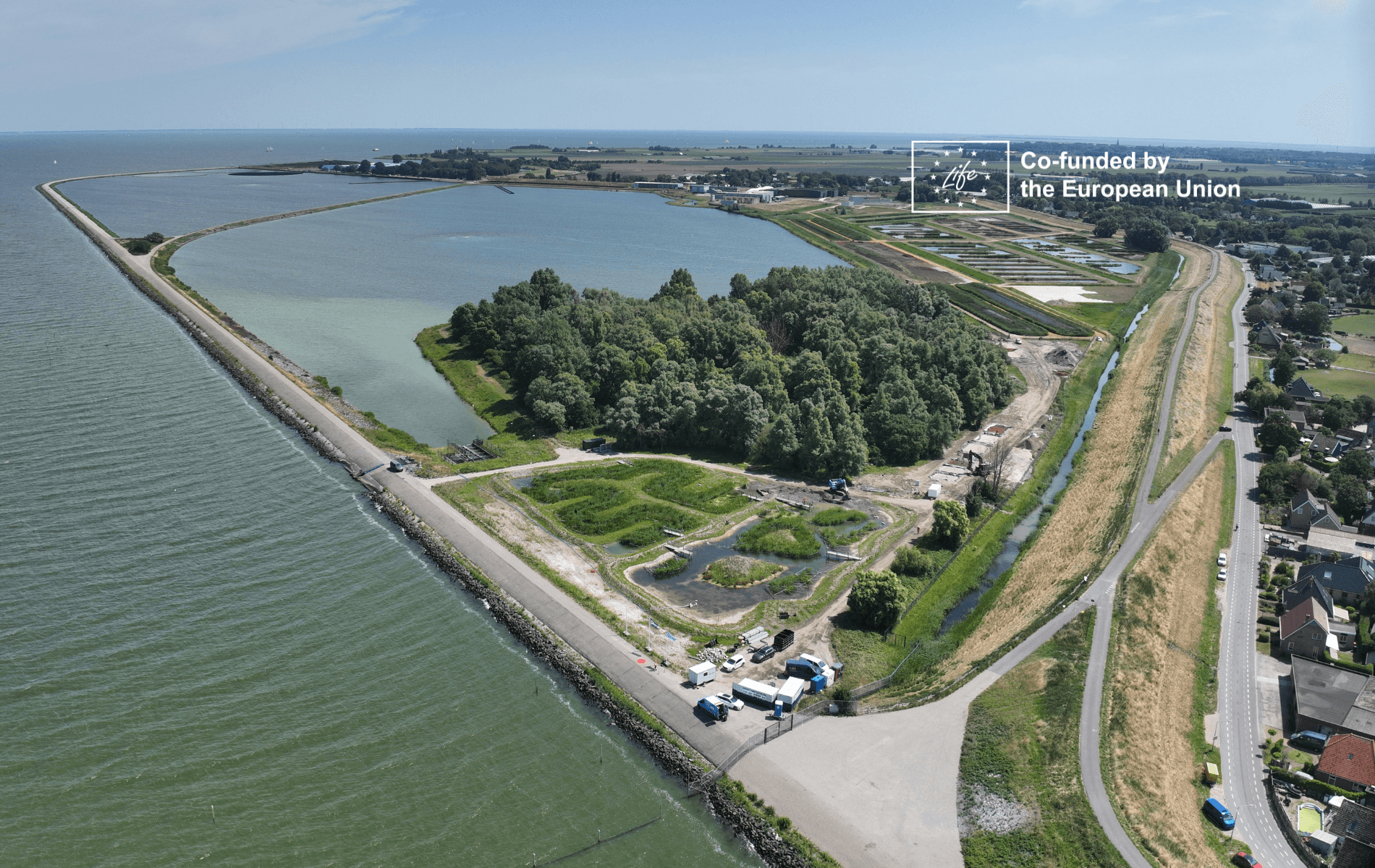
With the LIFE Watersource demonstration project, we are investigating how nature can help pre-treat water from Lake IJsselmeer before we turn it into drinking water. At the same time, we are strengthening the ecology and making the drinking water production process more sustainable. In short: we use natural processes where possible and technical solutions where necessary.
Why LIFE Watersource?
The IJsselmeer is the most important source of drinking water for the province of North-Holland. Climate change, longer periods of drought and changes in water quality are putting increasing pressure on this source. That is why we are looking for new, sustainable ways to purify water. One option is to harness the power of nature, which is what we are investigating with LIFE Watersource.
The LIFE Watersource project runs from 2023 through 2028. On a site of approximately one hectare, we are testing how natural processes can purify the water before it reaches the existing reservoirs. We are using, among other things, reeds, wetlands, mussels, and aquatic plants.
The knowledge we gain during this project will support the further development of the IJsselmeer Climate Buffer. This knowledge may also be valuable for similar projects in the Netherlands and abroad. We are working together with CETAQUA and Aigües de Barcelona in Spain, as they may want to develop a similar nature-based purification solution in the future.

A journey through the purification steps
Water from the IJsselmeer flows through the different components. Each component contributes in its own way to the (natural) pre-treatment of the water.
Step 1: Musselzone
Did you know that mussels naturally filter algae, bacteria and other small particles from the water? This can already contribute significantly to the (pre-)purification of IJsselmeer water. With LIFE Watersource, we are investigating exactly how effective this process is.
Step 2: Two Different Purifying Landscapes
Within LIFE Watersource, we are investigating how two different purifying landscapes (a wetland and a river landscape) contribute to the pre-treatment of water from the IJsselmeer. Both landscapes have their own design, vegetation and flow characteristics, creating space for different natural processes to take place.
The river landscape is winding, with reed-filled banks, aquatic plants on the riverbed and a relatively fast flow. Together, these elements create favourable conditions for the natural purification of the water.
The wetland landscape, on the other hand, has a lower flow velocity, greater variations in elevation, gently sloping banks and plenty of space for plants to develop and habitat for animals. This more tranquil environment stimulates natural processes that can primarily contribute to greater biodiversity.
By monitoring both landscapes over several years, we will gain insight into how they develop and contribute to the natural purification of Ijsselmeer water, as well as to strengthening biodiversity.

Step 3: Siphon fish ladder
We are constructing a fish siphon that allows fish to swim to and from the IJsselmeer. At the same time, we are investigating whether fish use this area for spawning and for raising young fish.
Step 4: Constructed wetlands
After passing through the landscapes, the water can be further purified using constructed wetlands. These consist of basins filled with sand or gravel and helophytes, such as reeds. Through natural processes associated with these plants, nutrients are removed from the water.
We are comparing horizontal and vertical constructed wetlands with different types of substrate, including sand and gravel, to determine their impact on the water quality.
Step 5: Bank filtration
With bank filtration, the water flows through a thick layer of sand. As a final purification step, small particles and bacteria are removed from the water, similar to the natural purification process that takes place in the dunes.
Phase 1: Construction of landscapes and initial measurements
In May 2025, we started constructing the first components of LIFE Watersource: the two landscapes. We created a wetland and a river landscape and planted them with IJsselmeer reeds. We then filled the landscapes with water from the IJsselmeer so that nature could develop, and we started the first measurements.
Since then, we have been monitoring water quality, vegetation development, the presence of insects and the presence of birds. During construction, we used electric equipment.
Phase 2: Construction of the remaining purification elements
In June 2026, we started constructing the remaining components, including the mussel zone, constructed wetlands, bank filtration and the fish lift. After this second construction phase is completed at the end of 2026, LIFE Watersource will be fully operational.
From that point onwards, we will be able to monitor the water quality of all the purification components.
Phase 3: Research phase
Until at least summer 2028, we will monitor developments in the area. We will measure water quality, vegetation development and other important aspects. We will also monitor how much maintenance and management the area requires.
Smart monitoring and knowledge sharing
Throughout the project, we continuously measure water quality, plant development and the presence of animals. We collect all the data in a ‘digital twin’: a digital environment in which the results can be visualised.
This allows us to closely monitor all measurements, calculate different scenarios and predict how the system will develop over time.

Newsletter
Would you like to know more about the latest news surrounding the IJsselmeer Climate Buffer and LIFE Watersource?
Sign up for the newsletter below or view previous editions of the newsletter.

European collaboration
Sharing knowledge and exchanging experiences play an important role in this project. We receive funding from the EU LIFE programme and work together with several Spanish partners:
- Aigües de Barcelona, Barcelona’s drinking water company
- Cetaqua, a water technology institute
This collaboration contributes to research into how nature-based purification can be applied more widely. Water stress (shortage of sufficient clean freshwater) is expected to increase most significantly in Southern Europe in the coming years.
Spanish partners undertake:
- Analyse the social costs and benefits in Barcelona.
- Assess whether the plan is economically feasible.
- Investigate whether the project can be replicated in other areas and regions.
- Evaluate and monitor the benefits that nature can provide, such as pollination, water filtration and opportunities for recreation and relaxation.
Partners



Pagina in het Nederlands bekijken
Click below to read this page in Dutch.